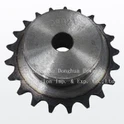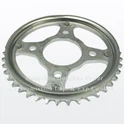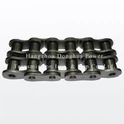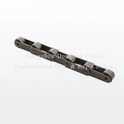
Number of sprocket teeth
In order to improve the smoothness of the chain drive and reduce the dynamic load, the number of teeth of the small sprocket is better. However, the number of teeth of the small sprocket wheel should not be too much, otherwise the =i will be large, so that the chain drive has a skipping tooth failure earlier.
After the chain has been in operation for a period of time, the wear causes the pin to become thinner and the sleeve and the roller to be thinned. Under the tensile load F, the pitch of the chain is elongated. After the chain pitch becomes longer, the pitch circle d moves toward the top of the tooth when the chain is wound around the sprocket.
Generally, the number of chain links is even to avoid the use of transition joints. In order to make the wear even and improve the life, the number of teeth of the sprocket is preferably the same as the number of links. If the mutual quality is not guaranteed, the common factor should be as small as possible.
Chain pitch
The larger the pitch of the chain, the higher the theoretical carrying capacity. However, as mentioned in the above section: the larger the pitch, the greater the dynamic load caused by the change of the chain speed and the impact of the chain link into the sprocket, which in turn reduces the chain carrying capacity and life. Therefore, the design should use a small pitch chain as much as possible. The actual effect of selecting a small pitch multi-row chain during heavy load is often better than selecting a large pitch single-row chain.
Center distance and chain length
If the chain transmission center distance is too small, the angle of the small sprocket is small, and the number of teeth of the meshing sprocket is small; if the center distance is too large, the chain is easy to shake. Generally, the center distance a=(30~50)p and the maximum center distance ≤80p.