


Motorcycle Sprocket
Motorcycle Sprocket Factory — For Street, Off-Road and Racing Applications
The rear sprocket is the last link in the chain drive of a motorcycle: it converts engine torque into wheel rotation, and every change to its tooth count and pitch diameter changes how the bike accelerates, how it revs, and how it behaves through a corner. Donghua has cut and hardened chain-drive components in Hangzhou since 1991, and we build motorcycle sprockets to ISO, JIS and ANSI pitch standards with hobbed tooth profiles, induction-hardened teeth and bore tolerances held to H7/H8. The same factories that produce the chain also produce the sprocket, so the tooth profile and the chain pitch are matched to the same production standard rather than to a second-hand supplier’s.


Product Categories
Latest Products
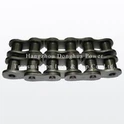
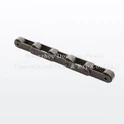
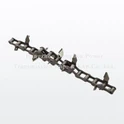
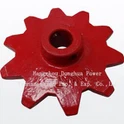

What Is a Motorcycle Sprocket?
A motorcycle sprocket is a toothed wheel that runs on the final drive chain, engaging it at a fixed pitch to transmit engine power to the rear wheel. Unlike a car sprocket, its tooth profile is short and its tooth count is small, because the chain it runs on moves at high speed and must stay light while absorbing the shock of a hard gear change.

Four parameters decide whether a sprocket is right
Sprocket selection is not a matter of the largest available size. Four figures determine whether the part will work, and all four must agree with the chain already on the motorcycle.
- Pitch — the distance in millimetres between chain roller centres. The chain pitch and the sprocket pitch must be identical. A 428 chain needs a 428 sprocket; a 520 chain will not engage a 428 sprocket at any tooth count.
- Tooth count (T) — together with pitch this fixes the pitch diameter and therefore the final drive ratio. Fewer teeth means faster acceleration and higher revving; more teeth means better highway cruising and less chain drag.
- Bore and hub — the interface to the wheel hub or cush drive. This determines whether the sprocket can be fitted at all, and it must be measured rather than guessed.
- Material and finish — carbon steel for street machines, hardened alloy for off-road shock loads, aluminium for weight-critical race applications, stainless for coastal and salt-exposed use.
How Tooth Count Changes How a Bike Rides
The final drive ratio is the relationship between the front sprocket and the rear sprocket. Fitting a larger rear sprocket multiplies the ratio, which shortens the gearing: the bike accelerates harder and pulls less, but tops out lower and revs the engine less at cruising speed.
| If you change the rear sprocket to… | Ratio | Effect on acceleration | Effect on top speed and cruising | Best for |
|---|---|---|---|---|
| Smaller tooth count | Lower | Noticeably sharper off the line and mid-range | Higher top speed, higher engine rpm at cruise | Racing, track days, sport motorcycles |
| Original tooth count | Standard | Factory balance of torque and revs | Factory balance of cruising comfort and fuel use | Daily riding, OEM replacement |
| Larger tooth count | Higher | Softer, more relaxed off the line | Lower top speed, lower engine rpm at cruise | Touring, long highway distances, heavy loads |
Practical note: tooth count alone does not change performance safely. Every change to the rear sprocket also changes the load carried by the chain and the front sprocket, so the chain line, chain length and front sprocket must all be re-checked. We specify the complete drive train together rather than selling a single sprocket into an unchanged system.
Which Motorcycle Application Are You Building For?
A street commuter and a motocross bike do not fail in the same way, and they should not be specified with the same material. Here is how each application loads a sprocket, and what it needs to survive that load.
Street and Commuter MotorcyclesLong-distance, moderate load, road salt and rain exposure. Requires a hardened tooth surface against chain wear and a coating that resists corrosion. Carbon steel with a zinc or black oxide finish is the standard answer. Durability on a long service interval
|
Off-Road and MotocrossShock loads, abrasive dirt, mud and water crossings at every corner. Needs deep case hardening and a tough core that will not crack when the bike lands. Alloy steel with induction-hardened teeth is the usual choice. Surviving impact without tooth fracture
|
Racing and High-PerformanceMarginal gains decide the result, so unsprung rotational mass is the enemy. Aluminium 6061 or 7075 machined to reduce weight, with tooth geometry optimised for chain engagement. Lightweight and dimensionally consistent. Low rotating mass and repeatable geometry
|
Scooters and ATVsHigh torque at low speed in a compact package, with a wide operating temperature range. Robust and cost-effective, with a focus on consistent dimensions across large production runs. Stable supply and consistent dimensions
|
Electric Motorcycles and Light VehiclesQuieter drivetrains put more attention onto chain and sprocket wear, and the absence of engine vibration means the drivetrain must run cleanly. Precision tooth profiles and tight run-out tolerance reduce the noise that would otherwise stand out without an engine masking it. Low noise and vibration-free operation
|
Choosing the Right Chain Pitch and Material
The table below covers the common pitch families and the material that suits each load case. If your motorcycle is not listed, send us the chain marking or a measured photo and we will confirm the specification.
| Chain pitch | Typical models | Tooth count range | Material for general use | Notes |
|---|---|---|---|---|
| 428 / 04C | 125cc commuter and small off-road bikes | 12T – 43T | 1045 / 45# carbon steel, teeth hardened | The most common entry-level pitch; hobbing stock is standard |
| 520 / 05C | 250cc – 500cc standard motorcycles | 38T – 52T | 1045 / 45# carbon steel or 40Cr alloy | Higher load than 428; check chain tension at fitment |
| 532 / 06B | Off-road and dual-sport bikes | 42T – 58T | 40Cr alloy, induction-hardened teeth | Shock load dominates; deep case depth required |
| XMR / 06C | Motocross and enduro competition | 48T – 60T | 7075 aluminium or hardened alloy | Weight reduction and impact resistance both matter |
| Custom / OEM | OEM programmes, prototype and aftermarket kits | Any | Per drawing and load case | Bore, keyway, spline and offset developed with your engineer |
About tooth profile standards: we cut motorcycle sprockets to ISO 606 for international and export equipment, JIS B 1801 for Japanese-brand machines and their replacement parts, and ANSI B29.1 where the chain specification calls for it. Because the pitch diameter is derived from pitch and tooth count, two sprockets with the same tooth count on different pitch standards are not interchangeable — which is why we ask for the chain marking before quoting.
The Factory Behind the Part
A motorcycle sprocket is a small component, but its failure mode is unforgiving: a cracked tooth ends the ride immediately. Everything below happens inside our own plants, which is why we can hold the tooth profile and the chain pitch to the same standard across repeat orders.


Testing, Certification and Engineering Support
Motorcycle chains and sprockets are safety-critical. We do not ask you to take our word for it — the laboratory reports, material certificates and inspection records are available for your own quality team to review.
Incoming quality controlEvery incoming batch of steel is checked against mill certificates before it enters production. Heat numbers are retained so any finished part can be traced back to the raw material it came from. |
In-process controlTechnicians monitor cutting dimensions, heat treatment parameters and hardness values during production, not only at the end. Out-of-spec parts are removed at the stage where they are found. |
Final inspectionBefore packing, parts are checked dimensionally with calipers, micrometers and CMM for critical profiles; tooth-flank hardness is verified against the heat treatment specification; run-out and concentricity are checked so the drivetrain turns without vibration. |


Developing a Sprocket That Does Not Exist Yet
Most sprocket problems are not catalogue problems. They are the result of a design constraint that nobody wrote down: an unusual hub, a drive ratio that has to hit a specific figure, or a weight target for a race programme. That is where a factory with its own tooling and heat treatment is worth more than a supplier with a catalogue.
|
✓
Tooth count and pitch diameterWe develop the gearing with you so the acceleration, top speed and fuel consumption targets are hit on paper before the first part is cut, rather than discovered on the test bench. |
✓
Hub design and bore configurationNon-standard wheel hubs, cush drives and proprietary mounting systems, including custom keyways, splines and bolt patterns, machined to your drawing or measured from a sample. |
|
✓
Material selection and hybrid designsWe advise on material grade for the load case, including hybrid constructions such as an aluminium centre for weight reduction with a hardened steel tooth ring for wear life. |
✓
Weight reduction and finishingCNC machining of non-critical material to reduce unsprung mass where the application benefits, plus aesthetic finishing, grooves and anodised colours for branded performance parts. |
How the process runs: our engineers work directly with your designers, starting from feasibility analysis and material selection, through prototype sampling, to final production. We accept 2D and 3D drawings, DXF files and physical sample parts, and we confirm manufacturability, tooling requirements and lead time in writing before any tooling cost is committed.
What a Motorcycle Sprocket Buyer Actually Gets
Sourcing drive components across borders carries real risk: a tooth profile that does not match the chain, hardness that varies between batches, or a lead time that stops a production line. Here is what we control, and what each of those controls means for your business.
A factory, not a trading companyChain transmission components have been made in Hangzhou since 1991, across six manufacturing bases in China, Germany, Poland and Japan, with six domestic subsidiaries and eight overseas ones. A trading company cannot hold a tooth profile steady from one batch to the next. We cut the lot.
|
The chain and the sprocket come from the same standardWe manufacture roller chain and sprockets in the same plants, so the pitch and tooth form are derived from one production standard rather than reconciled between two suppliers. No tolerance mismatch between the chain you buy and the sprocket that drives it.
|
Documentation your own quality team can acceptISO 9001, ISO 14001, ISO 45001 and IATF 16949 management systems, with an ISO/IEC 17025 CNAS-accredited laboratory for dimensional and mechanical testing. Inspection reports and material certificates arrive in a format your auditors already recognise.
|
Engineering confirmation before the orderStandard, pitch, tooth count, material grade and bore type are confirmed from a drawing, a sample or a measured photograph before anything is quoted or produced. The first order is right, so you are not writing off the cost of a second shipment.
|
Frequently Asked Questions About Motorcycle Sprockets
Send Us Your Motorcycle Sprocket SpecificationTell us the chain pitch, the tooth count, the material grade and the bore or hub type — or simply send a photograph of the sprocket you need to replace with a ruler in frame. Our engineering team will confirm the specification and return a factory quotation. If you are developing a new model, we can work from your drawings and propose a material and heat treatment plan before sampling. |
As one of the leading motorcycle sprocket manufacturers and suppliers in China, we warmly welcome you to wholesale quality motorcycle sprocket made in China from our factory.
heavy duty sprocket, value for money sprocket, sprocket packaging