1. Bending frequency and stress concentration effect
1. Increased chain bending frequency
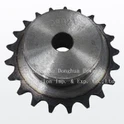
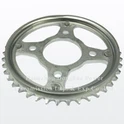
The small sprocket has fewer teeth, and the chain needs to bend with a smaller radius when meshing. Each time the chain rotates around the small sprocket, each link needs to undergo more frequent bending deformation, resulting in repeated deformation of the metal internal lattice structure, accelerating the initiation of fatigue cracks.
- Experiments show that: if the number of teeth is reduced by 30%, the chain bending frequency increases by about 50%, and the fatigue life may be shortened by more than 40%.
2. Increased stress concentration points
The arc between the small sprocket teeth is sharper, and the local stress distribution is uneven when the chain roller contacts the sprocket teeth. If there are defects such as original scratches and pits on the surface of the chain pin (common in chains with poor processing quality), these defects will become the starting point of fatigue cracks and expand rapidly under high-frequency bending loads.
2. The amplification effect of uneven load distribution
1. Increased force ratio of single tooth
The small sprocket has fewer meshing teeth (for example, only 3-4 teeth of a 10-tooth sprocket are meshed at the same time), resulting in a greater load on each tooth. This unbalanced load distribution will aggravate the alternating bending stress between the chain pin and the chain plate, causing early fatigue.
2. Effect of chain plate gap deviation
When the chain plate thickness is uneven or the assembly gap is too large, the high load characteristics of the small sprocket will amplify the dynamic impact force between the chain plates, causing the pin to bear additional bending moment during rotation.
3. Lubrication failure and increased friction loss
1. Lubricant extrusion effect
The small sprocket causes the chain bending angle to increase, the relative sliding between the chain links to increase, and the grease is easily squeezed out of the contact surface. Dry friction will occur between the pin and the bushing without effective lubrication, and the local temperature increase will cause micropitting, further reducing fatigue strength.
2. Reduced wrap angle leads to poor meshing
The wrap angle (the contact arc between the chain and the sprocket) of the small sprocket chain is small, resulting in a reduction in the number of meshing teeth. Incompletely meshed chain links may slip locally, generating impact loads and accelerating wear.
IV. Synergistic influence of materials and design
1. Surface treatment defect sensitivity
High-strength chain steel (such as 30CrMnSiA) is more sensitive to surface defects under small sprocket conditions. When the surface hardness of the pin reaches HRC53 or above, defects such as original pits and scratches will reduce fatigue strength by 30%-50%.
2. Contradiction of lightweight design
In order to reduce the rotational inertia of the small sprocket, thin-walled or hollow designs are often used, but this may sacrifice structural rigidity, cause sprocket deformation and change the chain force trajectory.
5. Overlapping risks of usage scenarios
In the following scenarios, small sprockets are more likely to cause chain breakage:
- High torque load (such as starting and stopping of construction machinery): When the chain is subjected to extreme tension, the crack propagation speed at the pin defect is accelerated by more than 10 times
- High temperature environment: The fatigue limit of metal materials decreases with increasing temperature. At 400°C, the fatigue life of the chain may be only 20% of that at room temperature
Optimization suggestions
1. Material improvement: Use nitrided 40CrNiMoA steel, and control the surface hardness at HRC45-50 to balance strength and toughness
2. Process control: The pin processing accuracy must reach IT6 level, and the surface roughness Ra≤0.8μm to reduce stress concentration
3. Lubrication strategy: Use high-viscosity grease containing molybdenum disulfide, and relubricate every 50 hours of operation