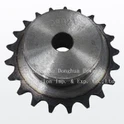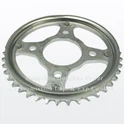
The motorcycle sprocket drive uses hard-toothed gears. Although the material cost and manufacturing cost are high, the overall economic benefits are relatively better than the medium and soft-hardened gears. The process of realizing the hard tooth surface of the gear mainly includes heat treatment methods such as carburizing, nitriding, carbonitriding, and surface quenching (including induction and flame quenching). Table 1.1 summarizes the characteristics comparison of different treatment methods of gears. Among them, high gluing load capacity and pitting resistance can be obtained by nitriding treatment, but this method has higher requirements on material quality, processing and heat treatment. The nitriding hardening layer is shallow, the core hardness is low, the impact resistance and the edge load resistance are poor; the induction quenching and flame quenching methods require careful preheating and strict material selection; while the carburizing quenching method is The technology is more complicated, but in the case of transmitting the same power (torque), the gear unit consisting of such gears has the smallest volume and the lightest weight (same bearing capacity), and the overall price is the lowest. It can be seen that the gear obtained by the carburizing and quenching method has higher performance than other treatment methods. Therefore, at present, the method of manufacturing the hard tooth surface gear is mainly to use a low carbon high alloy forging for the gear blank, and after carburizing and quenching after the cutting process, the tooth surface hardness is above 56HRC, and the precision after grinding is up to the ISO standard level 6.