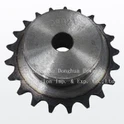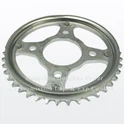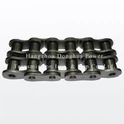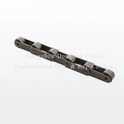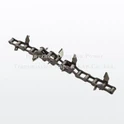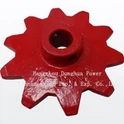
In mechanical manufacturing practice, gears undoubtedly play a vital role. It is the fundamental factor that determines whether the entire mechanical engineering can run smoothly.
Gears are common mechanical parts in people's lives. The condition for continuous transmission is that the coincidence rate must be greater than or equal to 1, which is the actual meshing line (segment) length, ratio, and pitch of the gear base circle. The ratio must be greater than or equal to 1. If the actual meshing line (the length of the base arc) is smaller than the pitch of the base circle, the ratio is less than 1, which indicates that the "distance" that a tooth turns is smaller than the pitch of the base circle, and it is disengaged, and the tooth cannot be guaranteed to pass With a tooth pitch, it can no longer mesh continuously, and the gears are driven by mutual meshing.
In the entire system of mechanical equipment, the function of gears is very prominent. In a sense, mechanical gears determine whether the entire mechanical equipment can work normally. As far as the mechanism of mechanical gears is concerned, it is mainly divided into four parts: gear teeth, grooves, tooth surfaces and ring gears. As far as gear types are concerned, we can divide them according to specific parameters, such as:
1. The shape of gears is divided into different shapes of gears. Mechanical gears are mainly divided into circular gears, linear gears, bevel gears and slash gears.
2. Gear surface, if divided by different gear surfaces, mechanical gears are mainly divided into external gears and internal gears.
3. The tooth profile of the gear can be divided into involute gears, high pressure angle gears, small pressure angle gears, cycloid gears, etc. Among them, the production cost of the involute gear is relatively low, and it has a very wide range of applications. The large pressure angle gear has strong structural stability, which can ensure the continuous operation of machinery and equipment, and therefore has a wide range of applications. However, compared with these two types of gears, the cycloid gears have higher production requirements, which also limits their wide application.