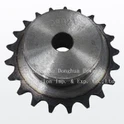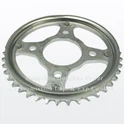
The following is a systematic solution to prevent sprocket fatigue fracture, combining material science, mechanical design and multi-dimensional optimization strategies for operation and maintenance management:
I. Material optimization and surface treatment
1. Selection of high-strength alloy steel
20CrMnTi, 40CrNiMoA and other alloy steels are preferred, and their fatigue strength is 30%-50% higher than that of ordinary carbon steel. Powder metallurgy steel (such as ASP-2060) can be used for high-load scenarios, and its microstructural uniformity can reduce stress concentration.
2. Surface strengthening process
- Nitriding treatment: After 8-12 hours in a 500℃ nitriding furnace, the surface hardness can reach HRC55-60, and the fatigue limit is increased by 40%.
- Laser cladding: Cladding a cobalt-based alloy layer (such as Stellite 6) at the root of the tooth can reduce the risk of crack initiation.
II. Structural design and parameter optimization
1. Selection of the number of teeth and load distribution
- Avoid using small sprockets with a number of teeth ≤15, and it is recommended that the number of meshing teeth ≥17 to disperse the load.
- Double-row sprocket design reduces the load on a single tooth by more than 50%.
2. Tooth curve correction
According to ISO 606 standard, the involute tooth profile is optimized, the radius of the tooth root arc is increased to 0.505 times the chain pitch, and the stress concentration factor is reduced (from 2.1 to 1.3).
III. Lubrication and maintenance strategy
1. Intelligent lubrication system
- Install an automatic oil injection device to replenish EP2 grade grease containing molybdenum disulfide every 50 hours of operation to reduce the friction coefficient to below 0.08.
- Use a fully synthetic polyether lubricant in a high temperature environment to ensure that the oil film strength is greater than 35MPa at 120℃.
2. Wear monitoring technology
- Use an ultrasonic thickness gauge to detect tooth thickness every month, and replace it immediately when the wear exceeds 10% of the original size.
- The infrared thermal imager monitors the sprocket temperature in real time, and warns of lubrication failure when the local temperature difference is greater than 15℃.
4. Manufacturing process and assembly control
1. Precision machining requirements
- The pin machining accuracy reaches IT6 level, the surface roughness Ra≤0.8μm, and the micro stress concentration source is eliminated.
- The tooth shape is processed by wire cutting, and the cumulative error of the tooth pitch is controlled within ±0.02mm.
2. Assembly specifications
- The sprocket and the shaft adopt H7/k6 interference fit to avoid micro-motion wear.
- The axial deviation of the two sprockets is ≤0.1mm/m to prevent unilateral fatigue caused by eccentric load.
5. Working condition management and life prediction
1. Dynamic load limit
The transmission system is monitored by torque sensor to ensure that the instantaneous impact load does not exceed 70% of the fatigue limit of the material (such as 40Cr steel load limit 1,200N·m).
Summary
Prevention of sprocket fatigue fracture needs to run through the entire life cycle of design-manufacturing-operation and maintenance. It is recommended to conduct full-size inspection every quarter and establish a digital health file (recording cumulative operating hours, maximum load, maintenance records, etc.). For key equipment (such as mining conveyors), a vibration analysis system can be installed to capture early crack signals in real time.