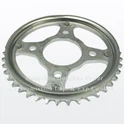
Hey there! As a supplier of standard pulleys, I've been getting a lot of questions lately about the difference between smooth - surface and grooved standard pulleys. So, I thought I'd take a few minutes to break it down for you.
Let's start with the basics. A pulley is a simple machine that consists of a wheel with a groove or a smooth surface around its circumference, and it's used to change the direction of a force or to transmit power between shafts. Standard pulleys are those that meet certain industry - wide specifications, which makes them interchangeable and reliable for a variety of applications.
Smooth - Surface Standard Pulleys
Smooth - surface standard pulleys are exactly what they sound like. They have a continuous, unbroken surface around the outside of the wheel. These pulleys are often used in applications where a simple change of direction is needed, or when the belt or rope used doesn't require a specific groove to stay in place.
One of the main advantages of smooth - surface pulleys is their simplicity. They're easy to manufacture, which means they're generally more affordable than their grooved counterparts. This makes them a great option for low - cost or low - stress applications. For example, in a home workshop, you might use a smooth - surface pulley to change the direction of a rope for a simple lifting mechanism.
Another benefit is that smooth - surface pulleys can work with a variety of flexible connectors. You can use ropes, cables, or even flat belts. This versatility is really handy if you need to adapt your system quickly or if you're working with non - standard materials.
However, smooth - surface pulleys also have some limitations. Since there's no groove to keep the belt or rope in place, there's a higher risk of slippage. This can be a problem in applications where precise power transmission is required. For instance, in a high - speed conveyor system, slippage could cause the conveyor to slow down or even stop, leading to production delays.
Grooved Standard Pulleys
Grooved standard pulleys, on the other hand, have one or more grooves cut into the surface of the wheel. These grooves are designed to fit specific types of belts, such as V - belts, timing belts, or flat belts with ribs.
The biggest advantage of grooved pulleys is their ability to prevent slippage. The grooves provide a positive engagement with the belt, which means that power can be transmitted more efficiently. This is crucial in applications where high torque or precise speed control is needed, like in industrial machinery or automotive engines.
Grooved pulleys also offer better alignment. The belt is guided by the grooves, which helps to keep it centered on the pulley. This reduces wear and tear on the belt and the pulley, and it can extend the lifespan of the entire system.
There are different types of grooved pulleys for different applications. For example, V - Pulley is designed to work with V - belts. The V - shaped groove provides a wedging action that increases the friction between the belt and the pulley, allowing for higher power transmission.
Metric Timing Pulley with Pilot Bore is another type. These pulleys are used with timing belts, which have teeth that mesh with the grooves in the pulley. This provides a very precise and synchronous power transmission, making them ideal for applications like robotics or CNC machines.
ISO High Quality Pulley meets international standards, ensuring high - quality and reliable performance. These pulleys are often used in demanding industrial applications where durability and precision are essential.
But grooved pulleys also have some drawbacks. They're more complex to manufacture, which makes them more expensive. And since they're designed for specific types of belts, they're less versatile than smooth - surface pulleys. If you need to change the type of belt in your system, you might also need to replace the pulleys.
Applications Comparison
Let's take a look at some real - world applications to see how these two types of pulleys stack up against each other.
In the agricultural industry, smooth - surface pulleys are sometimes used in simple irrigation systems. The low cost and easy installation make them a practical choice for small - scale farmers. However, in larger farms where more power is needed to operate heavy machinery, grooved pulleys are preferred. They can handle the high torque requirements and ensure reliable operation.
In the automotive industry, grooved pulleys are everywhere. They're used in the engine's accessory drive system to power components like the alternator, water pump, and power steering pump. The precise power transmission provided by grooved pulleys is essential for the smooth operation of these components. Smooth - surface pulleys, on the other hand, are rarely used in automotive applications because of the high - performance requirements.
Making the Right Choice
So, how do you decide whether to use a smooth - surface or a grooved standard pulley? Well, it all comes down to your specific application.
If you're working on a low - cost, low - stress project where slippage isn't a major concern, a smooth - surface pulley might be the way to go. It's simple, affordable, and versatile.
But if you need precise power transmission, high torque capacity, or good alignment, then a grooved pulley is probably the better option. Even though they're more expensive, the benefits they offer can outweigh the cost in the long run.
As a standard pulley supplier, I'm here to help you make the right choice. Whether you're a DIY enthusiast working on a home project or an engineer designing a complex industrial system, I can provide you with the information and products you need.


If you're interested in purchasing standard pulleys, I'd love to talk to you. We can discuss your specific requirements and find the perfect pulleys for your application. Just reach out, and we can start the conversation.
References
- Norton, Robert L. "Machine Design: An Integrated Approach." Pearson, 2012.
- Shigley, Joseph E., et al. "Mechanical Engineering Design." McGraw - Hill, 2015.