


Hey there! As a supplier of standard shafts, I've been in the game for quite a while, and I know how crucial it is to ensure the straightness of a long standard shaft during manufacturing. In this blog, I'm gonna share some tips and tricks that I've picked up over the years to help you achieve that perfect straightness.
First off, let's talk about why straightness matters. A shaft that's not straight can cause all sorts of problems, like vibration, noise, and premature wear and tear. In some cases, it can even lead to complete failure of the machinery. That's why it's so important to get it right from the start.
One of the most important steps in ensuring straightness is choosing the right material. You want to use a material that's strong, durable, and has good dimensional stability. Some common materials used for standard shafts include steel, stainless steel, and aluminum. Each material has its own unique properties, so it's important to choose the one that's best suited for your specific application.
Once you've chosen the right material, the next step is to cut it to the right length. This may seem like a simple step, but it's actually very important. If the shaft is too long or too short, it can affect its straightness. That's why it's important to use a precision cutting tool and to measure the length carefully.
After cutting the shaft to length, the next step is to machine it to the right diameter. This is another critical step in ensuring straightness. If the diameter is too large or too small, it can cause the shaft to bend or warp. That's why it's important to use a precision lathe or milling machine and to measure the diameter carefully.
In addition to cutting and machining the shaft, it's also important to heat treat it. Heat treating can help to improve the strength and hardness of the shaft, as well as its dimensional stability. There are several different heat treating processes that can be used, including annealing, quenching, and tempering. The specific process that you choose will depend on the material that you're using and the requirements of your application.
Another important factor in ensuring straightness is the use of precision tooling. This includes things like chucks, collets, and fixtures. These tools help to hold the shaft in place during machining and ensure that it's machined to the right dimensions. It's important to use high-quality tooling that's designed specifically for the type of shaft that you're machining.
In addition to using precision tooling, it's also important to use the right cutting tools. This includes things like drills, end mills, and taps. These tools help to remove material from the shaft and shape it to the right dimensions. It's important to use high-quality cutting tools that are designed specifically for the type of material that you're machining.
Once the shaft has been machined and heat treated, the next step is to inspect it for straightness. There are several different methods that can be used to inspect a shaft for straightness, including visual inspection, measurement with a straight edge, and measurement with a dial indicator. It's important to use a combination of these methods to ensure that the shaft is straight within the required tolerances.
If the shaft is found to be out of straightness, there are several different methods that can be used to correct it. One common method is to use a press to straighten the shaft. This involves applying pressure to the shaft at the point where it's bent or warped. Another method is to use a heat treatment process to relieve the internal stresses in the shaft and allow it to straighten itself.
In addition to these methods, there are also several different techniques that can be used to prevent the shaft from bending or warping during manufacturing. One technique is to use a support fixture to hold the shaft in place during machining. This helps to prevent the shaft from bending or warping due to the forces applied during machining. Another technique is to use a cooling system to keep the shaft cool during machining. This helps to prevent the shaft from expanding and contracting due to heat, which can cause it to bend or warp.
As a standard shaft supplier, we offer a wide range of products to meet the needs of our customers. Some of our popular products include the Axle Counter Shaft of Automobile Gear-Box, the Custom-Made Special Eccentric Shaft, and the Nickel Plating Flange With Shafts. These products are all made from high-quality materials and are designed to meet the strictest quality standards.

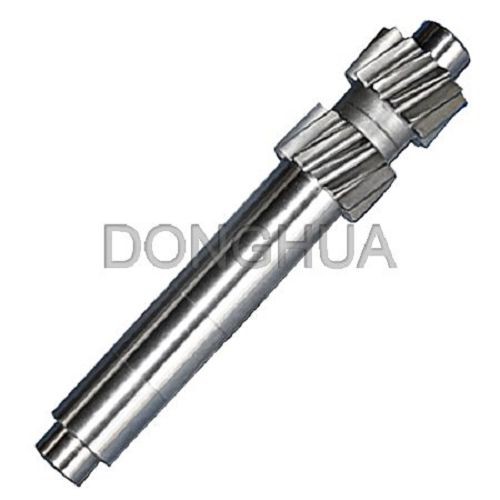
If you're in the market for a standard shaft, I encourage you to contact us to discuss your specific requirements. We have a team of experienced engineers and technicians who can help you choose the right shaft for your application and ensure that it's manufactured to the highest quality standards. We also offer a range of value-added services, including heat treating, surface finishing, and assembly.
In conclusion, ensuring the straightness of a long standard shaft during manufacturing is a critical step in ensuring the performance and reliability of your machinery. By choosing the right material, using precision tooling and cutting tools, heat treating the shaft, and inspecting it for straightness, you can ensure that your shaft is straight within the required tolerances. If you have any questions or need further information, please don't hesitate to contact us. We're here to help you get the most out of your standard shaft.
References
- ASM Handbook Volume 4: Heat Treating. ASM International.
- Machining Fundamentals. Society of Manufacturing Engineers.
- Materials Science and Engineering: An Introduction. William D. Callister Jr.


